|
HISTORY, DEVELOPMENT AND IDENTIFICATION GUIDE |
|
|
HISTORY, DEVELOPMENT AND IDENTIFICATION GUIDE |
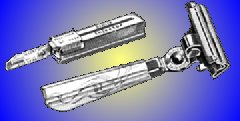
The Schick Injector Razor is a familiar piece of shaving hardware. Any day on eBay you can see dozens of them for sale, and relatively few bids out, at least for the common ones. After all, they all look just the same, don't they? "Butterscotch art deco handle and gold head".But look again, there's more to this razor than meets the eye. Subtle changes and refinements occurred on a regular basis. And these clues, plus packaging, allow us to date the razor with some degree of accuracy. At longer intervals, major styling changes occurred involving both the head and handle. But through it all, from 1935 right into the 2000's, the basic mechanism remained the same. A 1935 blade injector works just fine in a 2003 Injector Razor, and vice versa. And the blades from the 1926 Magazine Repeating razor, Col. Schick's first, will still work in today's razor.
This is one of the longest production runs for any model of safety razor, but likely at an end. It seems now that the current owners of the Schick name, Pfizer Warner-Lambert, are not selling the Injector Razor in stores in North America, although they still sell them in Japan, and over the internet. Will we soon see and end to this venerable little shaving machine?
A BRIEF HISTORY
Over the years the Schick Injector Razor has been made by at least four different parent companies. The original Schick Repeating Razors were made for the Magazine Repeating Razor Company by the American Chain and Cable Company in 1926. When Col. Schick decided to follow the dry shave road in 1928, he sold his interest in the Magazine Repeating Razor Company to American Chain and Cable, who continued to make and develop the razor until 1945. You can read about the history of Col. Schick and his major shaving inventions on our Col. Jacob Schick Page Although the razor we now know as the Schick Injector Razor was not produced until 1935, well after Col. Schick sold the company, one of the key patents was taken out by him in 1931, that being for the separate injector magazine with plug in key.In 1946, the Eversharp Co. bought out the rights to the razor, although the Magazine Repeating Razor Company continued to manufacture the razor until about 1950. Eversharp seemed to want to rename the Schick Injector Razor, perhaps because of confusion with the by then successful Schick Dry Shaver. Over the next few years, the name in advertising and on packaging changed to reflect their ownership. The name became Eversharp Schick Injector Razor, with the 'Schick Injector' part getting smaller and printed in a different font and colour that emphasized the phrase "Eversharp Razor". In fact, the ladies Fashion razor and its cheaper cousin, the Deb, were both marketed with only the Eversharp name on the razor, although the packaging still referred to Eversharp-Schick. Here's the sequence:
- 1946: Eversharp Schick Injector Razor
- 1947: Eversharp Schick Injector Razor (Eversharp larger than Schick)
- 1947: Eversharp Fashion Razor for women
- 1948: Eversharp-Schick Injector Razor (trying the hyphenated name game)
- 1951: Schick Injector Razor ("Eversharp" was a small banner across the "SC" of Schick)
- 1953: Eversharp Hydromagic Razor (had a tiny "Schick Injector" underneath)
- 1962: Lady Eversharp Beauty Razor (some said "by Schick")
- 1965: Schick Safety Razor Co., Division of Eversharp
It would appear that the name Schick was such a part of the product, that a change would not have been a wise marketing decision. Eversharp continued to dabble in putting their name on products like the Lady Eversharp Beauty Razor and The Lady Eversharp Band Razor right up to the time they sold their interest in the company, but they never fully re-created the Schick Injector Razor as the "Eversharp Razor".In 1969, Eversharp sold the Schick Safety Razor Company to Warner Lambert Company, a pharmaceutical conglomerate that still holds the rights, and they added Wilkinson Sword razors to their stable in the mid-1990's. Warner Lambert was in turn engulfed by pharmaceutical giant Pfizer, who among other things is now selling Wilkinson designed razors under the Schick name in North America. Unfortunately they terminated sales of the razor in stores in North America in about 1998, although they are still available on the internet. Through it all, the venerable Schick Injector has endured for almost 70 years.
COLLECTOR VALUE
The Schick Injector Razor is no more highly sought after than the common Gillette's of the same era. It was a mass produced article, and the numbers found for sale on auction sites like EBay attest to its popularity as a shaving tool, and its endurance as an object. The bare razor is not worth very much (or anything at all) unless it displays one or more of the following characteristics: unusual handle materials, precious metals, short production runs, intact packaging and paper, and special offers or promotions. The most valuable models normally seen for sale are sterling silver versions of the Magazine Repeating Razor produced in the late 1920's. After the 1930's, Schick rarely produced de luxe versions of their razors like Gillette and others did. Some notable exceptions: the gold plated and gold filled handles released by Eversharp in 1946 and 1947, the up-scale "Golden 500" model released in the early 1960's, and the International Silver version with the "Paul Revere" tableware handle that appeared in the early 1970's.
MODEL IDENTIFICATION AND DATING
Dating Schick Injector Razors is not as easy as dating some other popular razors like Gillettes. After the addition of the bakelite handle in 1936, the outward appearance of the razor changed very little until the mid 1950's. A period of updating and restyling followed until the basic format of the late 1960's, which endured with little change for another third of a century until late in the 1990's. These long periods of similar looking razors and the general absence of serial numbers or manufacturing codes linked to time, frustrate efforts to date examples of the razor over time.
However, there are several ways to place a Schick Injector Razor into at least a period of time, if not an exact year. There are manufacturing codes on most Schick razor products made since about 1960. On razors these codes relate to the manufacturing plant and machinery. But on blade cartridges made since about 1953, they relate to both plants and dates. Plastic razor cases produced since 1950 have dates built into their manufacturing codes. Instruction sheets may have printing dates. Razors in blister packaging also have manufacturing codes with date information, as well as copyright information that generally gives at least a few years span. So while we can't get it down to a particular year or quarter in most cases, we can generally get within a few years at least.
The Table below is a guide based on my own research and collection, and the "Types" are not company designations but ones I have made to classify different products that often went by the same trade name. I hope it helps you to understand and enjoy Schick Injector Razors better. If you find errors or have some information to add, please e-mail me. A companion page presents more detailed information in a chronological manner that might help you date your razor more specifically. See the Schick Injector Razor Time Line page.
Type*/ |
Description/ |
Head/ Handle/ Guard/ Blades |
Pictures
Click for larger image Hit "Back" to return. |
| Type
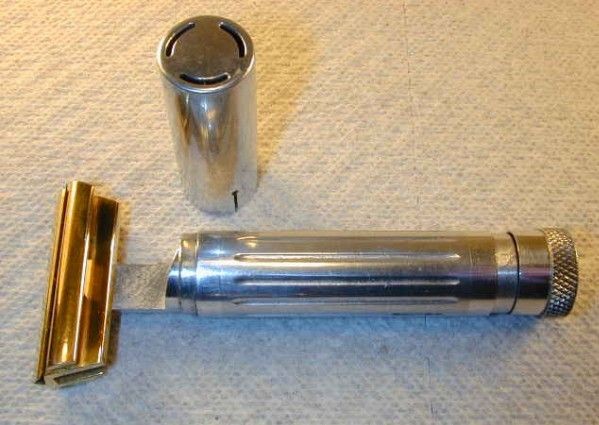
A Magazine Repeating Razor Magazine Repeating Razor Co. |
The first safety razor made by |
Folding Head. |
Type A
|
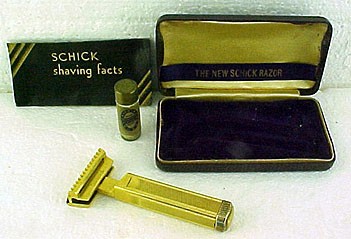
Type B Magazine Repeating Razor Co. |
3 basic models: |
Folding Head |
 Type B2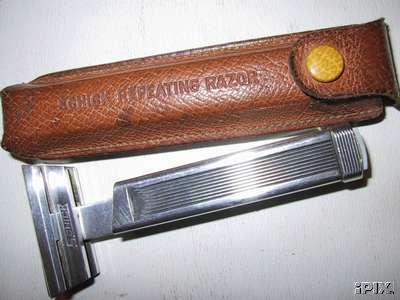
|
Type C Magazine Repeating Razor Co. |
Simplified loading mechanism did away |
Folding Head. |
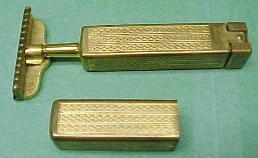
Type C1 Comb Guard
|
Type D Magazine Repeating Razor Co. |
The first Schick Injector Razor. |
Traditional Head. |
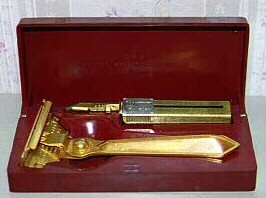
Type D
|
Type E Magazine Repeating Razor Co. |
First Schick with amber bakelite handle. |
Traditional Head. |
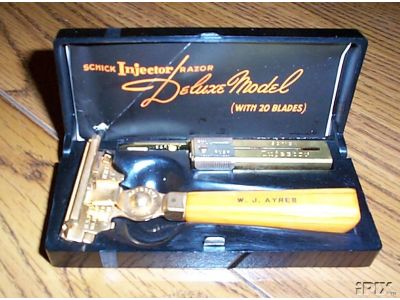
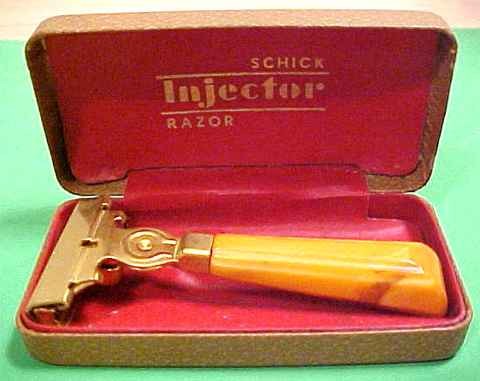
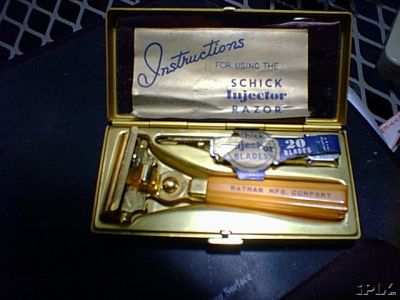
E3 Imperial Model |
Type F Magazine Repeating Razor Co. |
Cast alloy handle also forms guard. |
Copper and Alloy Head, Cast alloy handle. |
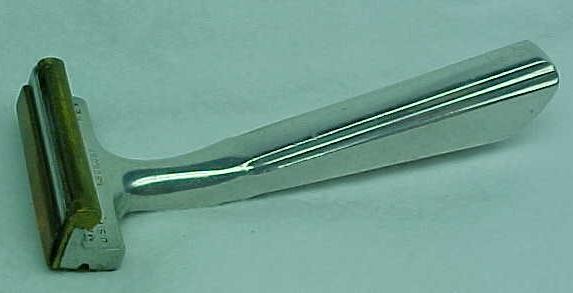
Type F Alloy Razor
|
Type G Eversharp Inc. |
Eversharp Shick Injector Razors: |
Traditional Head. various finishes |
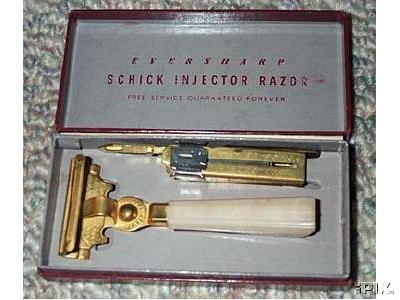
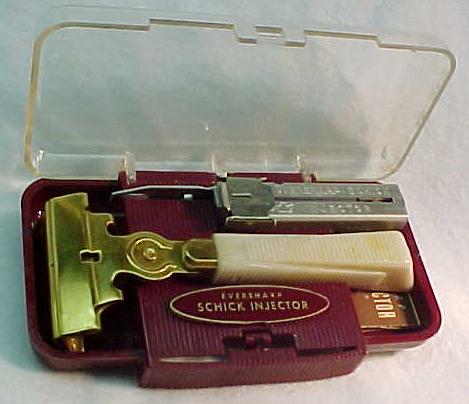
|
Type H Eversharp Inc. |
H1: Ladies Fashion Razor |
Compact and flat Integral spring |
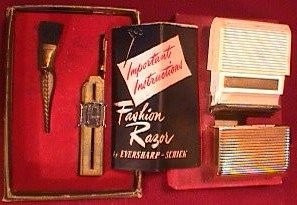
Type H1 Fashion Razor
|
Type I (and Hydro-magic) Eversharp Inc. |
The first major change in 20 years. |
Triangular, Short square ribbed handle |
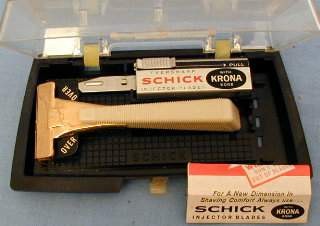
Type I1, later case.
|
Type J Eversharp Inc. |
Like I model with long round handle. |
Triangular, |
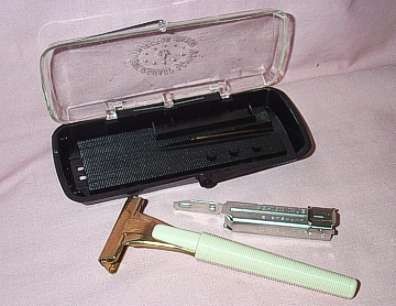
Type J1, early case.
|
Type K Eversharp Inc. |
K1: Handle tipped with metal ferrule, All with HydroMagic lever |
Triangular, Long round ribbed handle. |
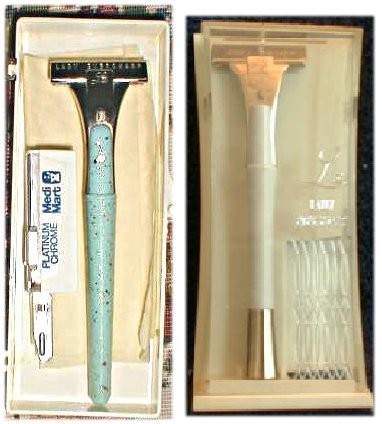
Type K2
Type K1
|
Type L Eversharp Inc. and Warner Lambert Company |
L1: Smooth back on handle ribbed below |
Triangular, Various ribbed handles, |
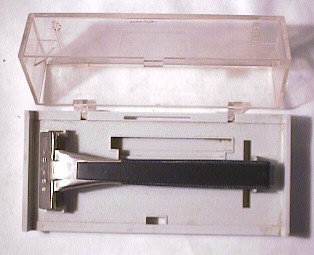
Type L1
|
Type M 1965 to 1972 |
Like L models but with blade adjustment knob |
Triangular, Square black |
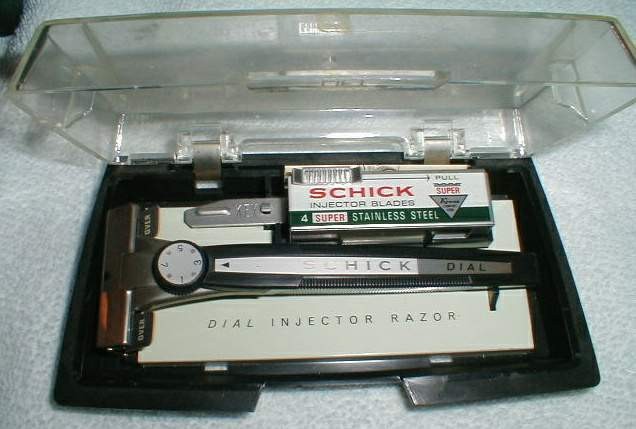
Type M1 Schick Dial
|
Type N Warner Lambert Company |
N1: Handle with chrome accent strip |
T shaped head, Black plastic various |
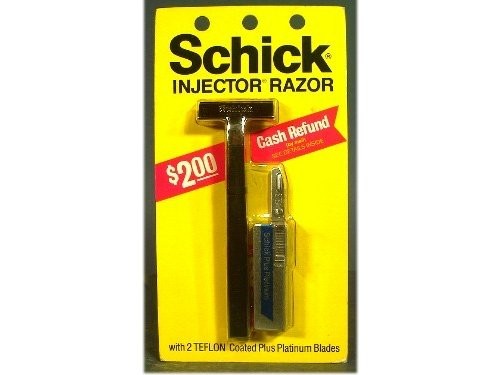
Type N1
|
Type O Pfizer Warner Lambert Company |
Stainless Steel handle integrated in head. |
Modern triangular head Stainless steel and |
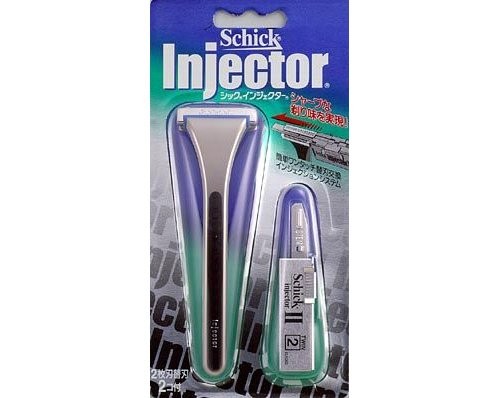
Type O (Japan)
|
Return to Top of Table
*Footnote: Types as assigned by author for classification purposes; not company design or model designations.
Copyright: Classification, descriptions and design © 2003 Alan G. Appleby. Any use must include web site identification and URL reference and/ or link. No commercial use.
Thanks: to Rokusan and Komaham for information and clarification on several models listed above.
Disclaimer: This information is provided for personal and recreational use only, and is not guaranteed to be accurate. All trade names are copyright to their respective owners.
Notice: If there is any information on this page which you believe to be injurious or privileged to you., please e-mail me your concerns.